We develop WebGIS applications for our customers that meet the respective project requirements and our high standards of functionality, usability and maintainability. For this purpose, we often use GeoExt, which uniquely combines the advantages of its two basic libraries ExtJS and OpenLayers, and thus represents a wonderful basis for specific further development for us.
GeoExt is currently available in version 2.0.2 and is based on OpenLayers 2.13.1 and ExtJS 4.2.1. In the meantime, however, both libraries have introduced new major releases that bring new functionalities. OpenLayers 3 is a complete redevelopment and inspires with incredible functional diversity, excellent performance and a redesigned code structure. In addition to numerous bug fixes and new features, ExtJS 5 also brings support for tablets, so that parallel development for different end devices is partially obsolete.
A future version of GeoExt should benefit from these changes, and therefore the project plans to support the latest stable main versions of OpenLayers and ExtJS. We at terrestris will actively participate in this process and try to contribute our expertise and experience in the form of code and project management (for example via Marc Jansen, who is a member of the Project Steering Committee of the project).
Presumably in two steps, future versions will bring support for the underlying new versions of the libraries mentioned (the version designations are naturally of a preliminary nature):
- GeoExt 2.1.0 will probably be based on OpenLayers 2.13.1 and ExtJS 5
- GeoExt 3.0.0 then relies on OpenLayers 3 and ExtJS 5
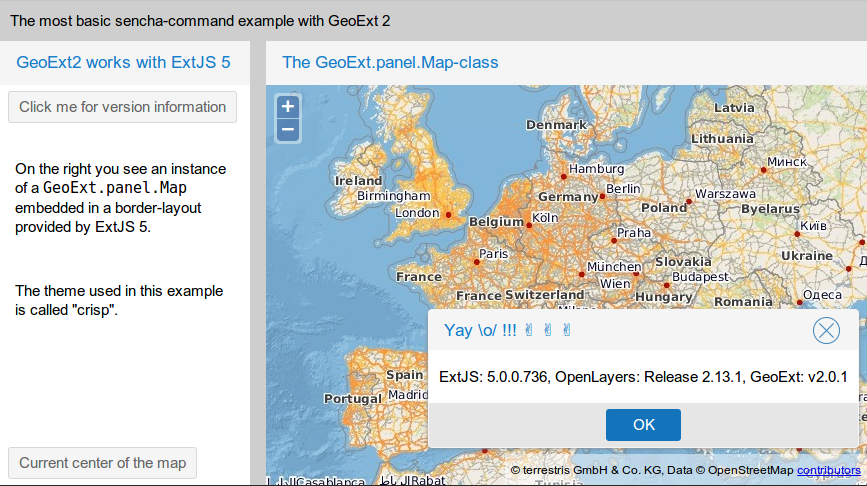
Work on ExtJS 5 support is already underway. In addition to a rudimentary proof-of-concept, there is also a so-called pull request with the first executable code, which is already performing its services in a real-world application. A GeoExt 2.1 version that supports ExtJS 5 is very likely and is expected to be released within the next few months.
With regard to OpenLayers 3 support, theoretical preliminary work has been done so far. The approach of Christian Mayer, who already worked on a generic interface to support different map libraries at a FOSSGIS CodeSprint last year, should certainly be emphasized here. We hope to be able to continue working here, so that GeoExt 3 may be able to support any map libraries. The development of this GeoExt version is still in an extremely early stage and it is impossible to predict whether and when it will appear.

All these developments are currently taking place and we would be pleased if further persons or institutions would participate in the implementation. Everyone is cordially invited to participate on the mailing lists or at github. Influence the future GeoExt developments.
If you have specific requests for the next versions of GeoExt, need help with the development or operation of GeoExt map applications or have further questions about WebGIS, please contact us.