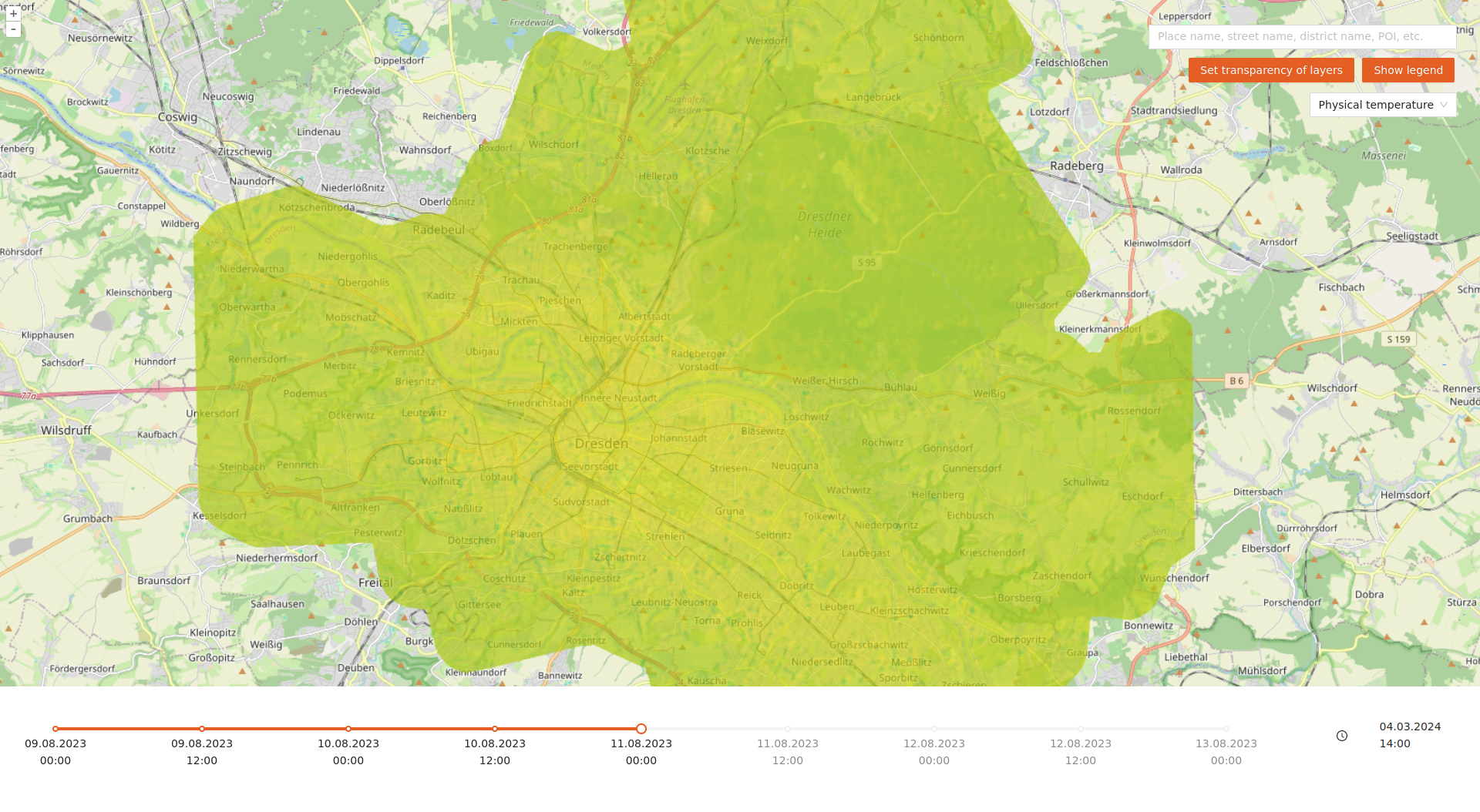
At the end of March, the KLIPS research project, funded by the Federal Ministry for Digital Affairs and Transport, will be successfully completed. The aim is to identify heat islands in cities and reduce or avoid them in the future. The AI-based information platform in KLIPS can be used to predict and simulate the heat island effect in cities.

In the course of climate change, heat islands are also an increasing health risk for the urban population in Central Europe and are now causing considerable infrastructure damage and costs, e.g. due to burst asphalt surfaces and deformed rails. With forward-looking measures, such heat islands can be reduced or avoided altogether. In the KLIPS research project (AI-based information platform for the localization and simulation of heat islands for innovative urban and transport planning), heat islands are measured with the help of an information platform and a sensor network, and the effects of possible measures are simulated using AI algorithms.

The Software AG is the consortium leader of the research project. The research partners are ERGO Umweltinstitut GmbH, the German Aerospace Center, the Fraunhofer Heinrich Hertz Institute, the Institute for Information Systems of Hof University of Applied Sciences, the Leibniz Institute for Ecological Spatial Development, the State Capital Dresden, Pikobytes GmbH, terrestris GmbH & Co. KG, meggsimum (Office for Geoinformatics Christian Mayer) and the City of Langenfeld as an associated partner.
Sensors for temperature and humidity
In the pilot cities of Dresden and Langenfeld, dedicated sensors were developed and installed for the continuous measurement of current temperature and humidity. First, the requirements of the pilot cities were determined and possible use cases were developed. After a successful test phase, around 300 sensors were installed in Dresden and 80 in Langenfeld at representative locations. Since then, these have been providing readings for temperature and humidity every minute. A data platform was developed for the acquisition, provision and visualization of the sensor data, and apps were provided for operating the measurement data. Focus areas were previously identified in workshops, expert interviews and technical discussions with the respective city administrations.

Data and analysis of heat islands
In addition to the sensor data, the project also used satellite data and existing data stocks from the pilot cities. These two sources provided information on weather (historical and current), climate, land cover, air pollutants, traffic, as well as digital elevation models and morphological information on buildings. On the basis of this data, detailed quantitative analyses of the relationship between buildings, sealing, transport infrastructure and urban warming could be carried out.
AI-supported analysis for heat forecasts
Several neural networks were regularly fed and trained with this data. AI-based methods were developed to model the relationship between urban structural parameters such as buildings, land cover and green space and the formation and characteristics of heat islands. These methods are intended to enable urban planners to accurately record the effects of structural changes on heat development and integrate them into urban planning strategies. In addition, AI-based models have been developed that enable a 48-hour forecast of heat development on hot summer days and can serve as a basis for heat action plans.
Demonstrator with integrated KLIPS services
KLIPS services, via which all calculated data can be retrieved, processed and displayed, provide cities with measurement and forecast data that they can integrate into their own IT and urban planning via standardized geoinformation interfaces. To illustrate this, a demonstrator was developed in the project, into which the KLIPS services are integrated. It offers various dashboards on which the measured air temperature and humidity, the heat index, the heat island effect and the temperature difference to the surrounding area can be queried at the current time and in a 48-hour forecast. The dashboards are web-based and accessible via a browser.

Legal assessment and data governance
Within the framework of the project, the data used was legally assessed in order to enable legally compliant use and provision as open data in the Mobilithek, the BMDV’s platform for open mobility data. In addition, a data governance concept was created, which serves to implement and document compliance with the legal requirements for data use. In the process, initial approaches to documenting data quality were identified, which are decisive in determining liability for data-driven processes.
KLIPS can be transferred to all municipalities
“The special thing about KLIPS is that it not only provides a comprehensive overview of the current heat islands in the urban area, but also enables simulations of future heat islands with the help of AI methods,” emphasizes Christian Gengenbach, Vice President Research & Development at project coordinator Software AG. “With this knowledge, the formation of heat islands can be prevented in advance. The data obtained in the project can help many cities to deal with heat events in the future. This is because the findings and results of KLIPS can generally be transferred to all municipalities.” Steffen Rietzschel, Head of the Office for Economic Development of the State Capital Dresden, adds as an outlook: “With the combination of AI and temperature forecasting, the KLIPS project has opened up a new topic, especially for municipalities. This should be further deepened in follow-up projects on heat prevention.”
The KLIPS project is funded by the Federal Ministry for Digital Affairs and Transport with a total of 2.3 million euros as part of the mFUND innovation initiative.
About the mFUND funding program of the BMDV
Within the framework of the mFUND funding program, the BMDV has been supporting research and development projects relating to data-based digital innovations for Mobility 4.0 since 2016. The project funding is supplemented by active professional networking between stakeholders from politics, business, administration and research and the provision of open data on the Mobilithek. Further information can be found at www.mfund.de.